
Microstructure Comparison
Comparative micrographs show how the grain structure changes after process optimization.
R&D and Innovation in NdFeB Magnets
Our R&D work focuses on three connected areas: grain refinement, dual-alloy processing, and cerium-containing NdFeB materials. The original micrographs, process diagrams, product photographs, and measurement results below are taken from the supplied technical development material.

Microstructure Development
A finer and more uniform grain structure supports targeted improvements in coercivity, temperature stability, and process consistency. Development combines microstructure imaging, particle-size analysis, and magnetic-property measurements.
Comparative micrographs show how the grain structure changes after process optimization.
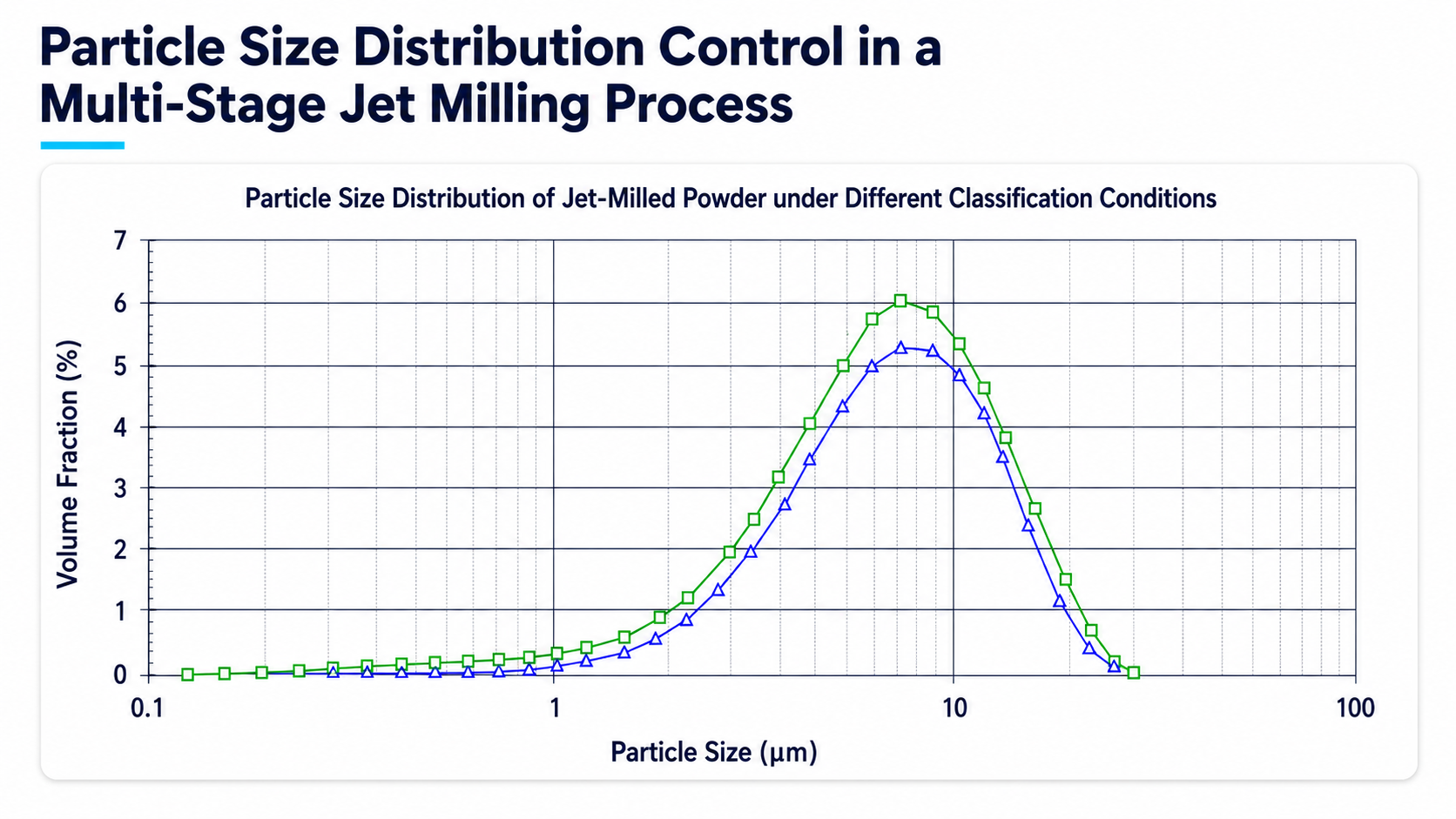
A narrower powder distribution supports more uniform compaction and a repeatable sintered structure.

Fine grains and boundary structures are evaluated together to reduce local weak points.

Br, Hcj, and energy product are correlated with the corresponding process and microstructure data.

Process and Alloy Development
The dual-alloy process separates the production of the main alloy and an auxiliary alloy. Both starting materials are designed independently and then blended uniformly before the subsequent forming and sintering stages.

One starting alloy passes through powder preparation, pressing, and sintering.

The main and auxiliary alloys are produced separately and combined under controlled conditions.
Independent alloy design increases flexibility in composition and grain-boundary chemistry, allowing magnetic performance, temperature behavior, and raw-material use to be balanced for the target application.

Resource-Efficient Materials
Cerium-containing NdFeB materials enable broader use of available rare-earth resources. Partial substitution must be coordinated with alloy design, microstructure, and heat treatment so that the required magnetic properties are maintained.
Cerium is evaluated as part of resource-efficient NdFeB alloy concepts.
Phase composition and distribution are tuned for stable magnetic behavior.
Powder preparation, alignment, sintering, and heat treatment are optimized as one process chain.
We support material selection, microstructure engineering, magnet design, and simulation-led development.